
The House Martin is a migratory member of the Swallow family (Hirundinidae, sometimes referred to as hirundines) with glossy blue-black upper parts and pure white under parts. It has a distinctive white rump contrasting with a dark forked tail and, although difficult to see, white feathers covering its legs and toes. It spends much of its time in flight, feeding on a variety of insect prey.
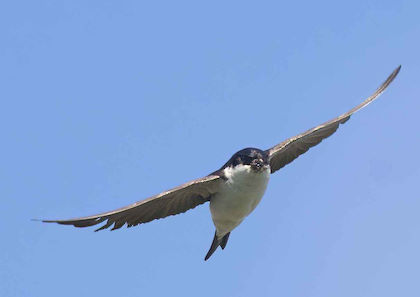 House Martin in flight © John MillerHouse Martins are still a familiar summer visitor to our villages and towns, nesting under the eaves of houses. However, they have declined across much of England in the past 25 years. In 2002 they were moved from green to amber in the list of Birds of Conservation Concern and in 2020 they were Red-listed due to worsening declines in the breeding population. The BTO Breeding Bird Survey indicates a 42% drop between 1995 and 2023.
These declines have been most severe in the south and east of England. The reason for this decline is unclear but is possibly linked to the fact that nests built on PVC substrate as opposed to brick, wood or concrete, have a much lower breeding success due to nests collapsing.
To assist with the conservation of this wonderful little bird, Cornwall Birds (CBWPS) have launched the Cornwall House Martin Project. The project aims to raise awareness about House Martin declines, build on our knowledge of nest sites and prepare for a possible county-wide survey in the future and the provision of artificial nest cups.
How can I help?
There’s lots of ways to get involved but most importantly we need to know where House Martins are nesting. Placing a nest site on the map and talking to the house owners about the plight of these endearing little birds is a great start. Here’s how to do it.