
Find out more about House Martins
When and where to look
House Martins are summer visitors to the UK, arriving in late March or April. Whilst they may be seen anywhere, breeding birds are usually found in villages and towns, agricultural landscapes with pasture and arable or wetland areas with a rich supply of insect food.
It is a familiar bird due to its habit of nesting in small colonies under the eaves of our homes. Traditionally, they nested on cliffs and in caves and this still sometimes occurs, more so in north Cornwall.
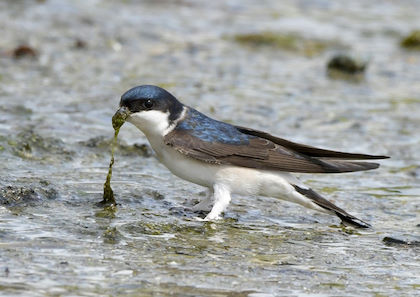 House Martin collecting mud © Deena SharpWhen they arrive, they will often fly up to potential nest sites or return to places where they have bred in previous years. House Martins construct nest cups from mud and may be seen collecting pellets from around puddles and pools of water. If you see this, watch which direction they fly off and follow to find the nest site.
Flocks may be seen overhead in early autumn as they gregariously catch insects in preparation for their return migration. Most will have left by October, but sometimes late broods are still in the nest. There have been winter records in Cornwall, but these are very rare.
How many eggs do they lay?
Each nest will contain 4-5 eggs. These are incubated by both the male and female and hatch after 13-19 days. Chicks remain in the nest for 19-25 days.
How many broods in a year?
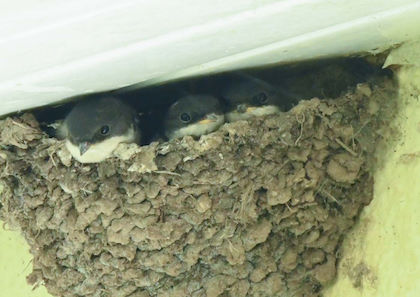 House Martin chicks in nest © Deena SharpHouse martins prefer to nest in colonies and pairs can raise two or three broods of young during a breeding season, which can last into September/October. Raising two broods helps to ensure that enough juveniles survive to maintain the population. There are records of young from the first brood helping to feed second brood chicks.
The second brood usually occurs in old nests in good condition that require a little repair or artificial nests. A new nest requires time and effort to complete, it can take two weeks or more to build, which may be why newly built nests are less likely to be used for more than one brood in their first season after construction. They may also contain parasites, unhatched eggs or dead chicks from the first brood.
Where do they spend the winter?
House Martins migrate to Africa, but the exact non-breeding range of birds that breed in the UK & Ireland is still unknown.
What is a House Martin’s life expectancy?
Often, only two years once they reach breeding age in their first year. The oldest House Martin ever recorded is just over 7 years (from ringing data). This bird probably travelled more than 70,000 km in its lifetime .
How can I help improve breeding success?
House Martin nests built against PVC soffits and facias have a lower success rate because the mud does not adhere well and nests sometimes fall. Building a new nest may take a thousand trips to collect mud, taking two or three weeks. This reduces the available time for nesting and uses energy that could be directed into egg production.
Added to this is the availability of soft mud during periods of hot dry weather. Provision of just a square metre of sticky mud can help.
They will however readily accept artificial nest-cups that can be securely screwed to the wall. The provision of nest-cups saves the adults time and energy, so that they may even manage three broods in a season.
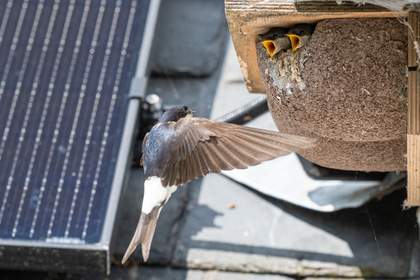 House Martin nest in Artificial Nestcup © Richard BowlerNest cups can be purchased ready made or you can even make your own! The national charity House Martin Conservation lists recommended suppliers and gives advice on the siting of nest cups.
https://housemartinconservation.com/artificial-nests
House Martin Conservation has lots of other resources that will help you help House Martins.
How to avoid droppings
Some people destroy House Martin nests (which is illegal once nesting has begun) because the droppings ejected from the nest cause a lot of mess below. One way to avoid this is to fix a dropping board to the wall about 2 metres below the nest. The board will catch most of the droppings and can be scraped off at the end of the season.
If you are fitting nest cups, avoid placing over windows because you won’t be able to attach a droppings board.
How can Cornwall Birds help?
Cornwall Birds (CBWPS) has been recording all species of wild bird in Cornwall for over 90 years. It is apparent that House Martins along with many other species has declined.
We have set up a nestbox fund and may be able to supply House Martin nestboxes to schools, colleges and public institutions. Each application will be assessed on its merits.
Between 2001 and 2010 we organised a County Bird Atlas and you can see where House Martins were reported here.
Between 2027 and 2031 we will be repeating the Bird Atlas to see how populations have changed.
Please address enquiries about the Cornwall House Martin Project to